
Twin events this week demonstrated why so many Washingtonians don’t feel like there’s anyone in charge who represents their interests.
First, President Trump “pulled out” of the UN Framework Convention on Climate Change. I put those words in quotes, because it’s not clear he has the legal authority to individually abrogate the treaty that was signed and ratified during the George H. W. Bush administration. But since the current Congress seems utterly uninterested in defending the powers granted it by Article I of the U.S. Constitution, we will see.
Virtually every country in the world is a signatory to this agreement. It provides the framework under which the Kyoto Protocol and Paris Agreement were negotiated to slow the damaging impacts of global warming. Abandoning this agreement is just one more step in America’s rapid decline in global leadership and influence.
It’s the foreign policy equivalent of a toddler sticking their fingers in their ears and screaming “NYAH NYAH NYAH” right at the moment the progression of global warming is becoming more obvious by the day.
And yet.
This was also the week that officials in the Washington Department of Commerce acknowledged that the 3,600 projects funded by the Climate Commitment Act would not, in fact, reduce greenhouse gas emissions (GHGs) by 8.6 million tons, as they had originally estimated, but rather a number 96% lower:
In reality, those 3,600 projects are expected to cut emissions by nearly 308,000 tons over their lifespan, 1/27th of their original estimate. Former state Sen. Joe Nguyễn, who now heads Commerce (but is soon leaving), said the error came from a rounding issue for a single program funded by the climate account. “This was literally just a fat-fingers situation,” Nguyễn told The Seattle Times.
Credit to Todd Myers of the Washington Policy Center, who first noticed the implausibility of the state’s estimates:
The remaining $3.5 million funded 170 projects that Ecology’s report claims reduced emissions by 3.5 million metric tons. To put that in context, that is equivalent to 60 percent of all energy-related residential CO2 emissions in Washington state for all of 2023. The notion that heat pumps and other upgrades at just 170 buildings could reduce the equivalent of 60 percent of the CO2 emissions from homes is clearly incorrect.
Last summer, the WPC produced another eye-opening report that showed just how few CCA dollars flow into projects that are intended to reduce GHG emissions. The low reductions in GHG emissions are practically baked into how the spending is allocated.
One of my two college majors was Economics. A carbon tax is a sound public-policy approach to reducing greenhouse gas emissions. If you tax something, you get less of it. And you force GHG emitters to “internalize” the cost of what otherwise are negative externalities.
Washington never needed to spend a dime of Climate Commitment Act revenue on new projects for the bill to accomplish its goal of reducing carbon emissions. The new tax system was going to do that work for us, even if it had been revenue-neutral, such as by pairing it with an equivalent sales tax deduction.
As the program exists, though, it has real impacts on working families. The producers facing new taxes were always going to pass those costs on to consumers. So filling up the car costs more. Heating your house costs more. The cost of just about every physical product goes up a little bit just because it costs more to move things from the field or factory to the store.
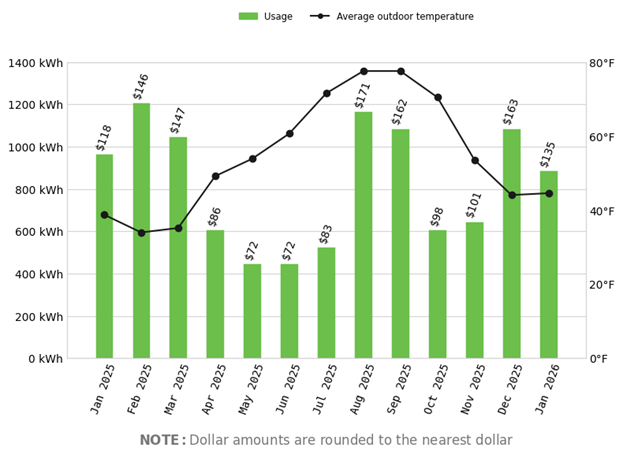
As I was writing this, we got our power bill. It was warmer and we used less electricity during this year’s January billing period. Our bill still went up:
It’s the same story for many working families.
Now, even though they don’t help to reduce emissions, many of the projects funded by the Climate Commitment Act are beneficial to Washington communities. But at a time when lawmakers are considering huge cuts to important social services and/or using those potential cuts as a reason to consider new taxes, this is exactly the place in the budget where there should be an accountability and outcomes review.